Insurers Gain Reasons to Raise Rates (via SHINKLEink)

Tags

, , ,

As oil continues to flow out of Deepwater Horizon, experts estimate the oil may reach the coast of North and South Carolina by the end of the month. Insurers are already estimating billions in cost which could increase as business owners begin filing suit.

Patrick Semansky - AP

Publication Date 06/07/2010 Source: Dow Jones News Service WSJ(6/7) Insurers Gain Reasons To Raise Rates (From THE WALL STREET JOURNAL)For commercial insurers, the Gulf of Mexico oil spill and the volcanic-ash disaster may prove relatively light in claims costs but may give the firms justification to raise premiums for some types of coverage. An explosion aboard the Deepwater Horizon oil rig in April, and the subsequent leak that has since become … Read More

via SHINKLEink

When Is A Borrowed Car Covered Under Your Automobile Insurance Policy As A Substitute Vehicle?

Tags

, , , , ,

Consider the following, you are a small businessperson and the vehicle

Jennifer Meyers / The Post-Standard

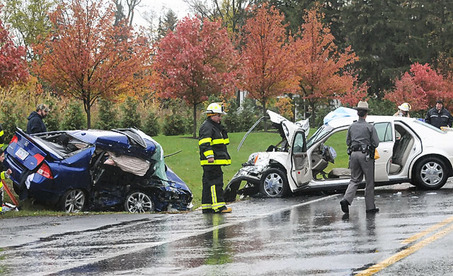
you normally drive is owned by and insured under your business automobile insurance policy. One day your normal vehicle, the one insured under the policy, is low on gas or maybe it needs new brakes so you borrow your wife’s car for the day. Unfortunately, you are involved in a horrible accident and incur several hundred thousand dollars worth of medical bills. The person who hits your vehicle has little or no insurance. Your wife’s vehicle has a $100,000 policy. The company policy for the vehicle you normally drive is $1million in coverage. Are you covered under your company’s automobile policy’s uninsured or underinsured motorist coverage? The answer is it depends.

Typical UIM language in an automobile policy might include the following:

B. Who is An Insured

If the named insured is designated in the Declarations as:

2. A partnership, limited liability company, corporation or any other form of organization then the following are “insured”:

a.         Anyone “occupying” a covered”auto” or a temporary substitute for a covered “auto”. The covered “auto” must be out of service because of its breakdown, repair, servicing, “loss” or destruction.

The analysis to the above hypothetical revolves around determining what is meant by out of service because of a “breakdown, repair, servicing, “loss” or destruction” of your covered auto. In Ransom v. Fidelity and Casualty Co., 250 N.C. 60 (1959), the N.C. Supreme Court held that Francis Lee who drove his brother’s car because his own car was low on gas was not covered under his insurance policy because his car was not withdrawn from normal use. In Maryland Casualty Co. v. State Farm Mutual Automobile Insurance Co., 83 N.C. App. 140 (1986), the court held that Thomas who had borrowed a truck that day did not have coverage under his insurance policy because even though his covered vehicle was rusted and worn out it was not withdrawn from normal use. However, perhaps if your insured vehicle needed repairs you would be safe to borrow another car for the day. In Martini v. Companion Property and Casualty Ins. Co. the N.C. Court of Appeals found coverage for Douglas Martini who had borrow his wife’s car for the day because his Sequoia, insured under his company policy, was in need of new brakes. The court distinguished Martini’s case from Ransom and Maryland and found the facts more in line with the decision in Nationwide v. Fireman’s Fund Ins. Co., 279 N.C. 240 (1971) which held that coverage did exist for a man who borrowed a vehicle while having his insured vehicle painted.

The moral of this story is be careful when you borrow someone else’s car that they either have adequate insurance coverage or that your own insured vehicle is truly out of service otherwise you might be left without insurance coverage.

NC Third Lowest in Tort Liability Costs

Tags

, , , , , ,

According to US Tort Liability Index: 2010 Report put out by Pacific Research North Carolina ranks 3rd just behind Alaska and Hawaii in tort costs and law. The Report attempts to measure which states have the highest and lowest tort liability costs. The worst? New Jersey with New York and Florida joining it in the bottom three.

The Report goes on to classify states as either saints, sinners, salvageable, or suckers based on tort litigation risks, lawsuit awards, and the strength of tort laws on the books.

The saints: Alaska, Kansas, Louisiana, Ohio, and South Carolina.

The sinners: Alabama, California, Illinois, New York, and Pennsylvania.

The salvageables: Colorado, Florida, Georgia, Mississippi, Oklahoma, and Texas.

The suckers: Idaho, Iowa, North Carolina, North Dakota, South Dakota, and Virginia.

Want to know more see the full Report at http://www.pacificresearch.org/docLib/20100525_Tort_Liability_Index_2010.pdf

Detecting Fraud With An Insurance Data Warehouse (via Business Guidance Systems™)

Insurance fraud in North Carolina is costing billions. According to Wayne Goodman, approximately 10% of all claims in NC are fraudulent totally nearly $120 billion in loses. While it may seem like this in issue that only affects the insurance industry it is not. Consumers pay for the fraudulent claims in the form of higher insurance premiums.

We all pay for the cost of crime, and preventing it is much more appealing for insurers than accounting for it after the fact. Insurance losses related to crime and abuse are factored into companies’ rates as a cost of doing business. Relatively few instances of fraud affect the balance of the companies’ customers. Insurers have implemented sophisticated and powerful computer systems to try to accurately identify the losses as soon as possible af … Read More

via Business Guidance Systems™

Statute of Repose for Products Liability Now 12 Years

Tags

, ,

Effective October 1, 2009, the statue of repose for products liability is 12 years. A statute of repose bars any suit that is brought after a specified period of time even if the plaintiff has not been injured at that time. For example, under the new law a plaintiff could not sue a defendant manufacturer 13 years after purchasing a product made by that manufacturer even if the plaintiff was not injured by the product until that time. The new law sounds plaintiff friendly but in fact is a minor blow to defendants as the old law limited actions to only six years.

Cyber-Bullying is a Misdemeanor

Tags

, ,

According to http://www.stopcyberbullying.org/index2.html, “Cyberbullying” is when a child, preteen or teen is tormented, threatened, harassed, humiliated, embarrassed or otherwise targeted by another child, preteen or teen using the Internet, interactive and digital technologies or mobile phones. It has to have a minor on both sides, or at least have been instigated by a minor against another minor. Once adults become involved, it is plain and simple cyber-harassment or cyberstalking. Adult cyber-harassment or cyberstalking is NEVER called cyberbullying.”

However, the new N.C. law applies to both adults and minors bullying a minor or in some cases the minor’s parent or guardian. The new law makes it unlawful among other things to build a fake website or profile, to post or encourage others to post private information about the minor, to break into an online account, and to post statements intended to harass a minor. The crime of cyber-bullying is a Class 1 misdemeanor is the person is an adult and a Class 2 misdemeanor is the person is under the age of 18 at the time of the crime.  Any misdemeanor in N.C. can carry a prison sentence of up to two years and may include fines.

N.C. Creates a Task Force on Childhood Obesity

Tags

, ,

Childhood obesity is a growing concern for both parents and the government.

“Results from the 2007-2008 National Health and Nutrition Examination Survey (NHANES), using measured heights and weights, indicate that an estimated 17 percent of children and adolescents ages 2-19 years are obese.” via Obesity and Overweight for Professionals: Childhood | DNPAO | CDC.

“Being overweight during childhood and adolescence increases the risk of developing high cholesterol, hypertension, respiratory ailments, orthopedic problems, depression and type 2 diabetes as a youth. One disease of particular concern is Type 2 diabetes, which is linked to overweight and obesity and has increased dramatically in children and adolescents, particularly in American Indian, African American and Hispanic/Latino populations.[9] The hospital costs alone associated with childhood obesity were estimated at $127 million during 1997–1999 (in 2001 constant U.S. dollars), up from $35 million during 1979–1981.[10]” via Childhood Obesity.

Given the growing concern, the N.C. legislature has formed a 12 member task force to study and recommend strategies for encouraging healthy eating and increased physical activity in children.

Texting While Driving Will Get You a $100 Fine

Tags

, , , ,

We have all seen that person in the lane next to us texting on the phone, eating a burger, and slurping down the soda all while driving with his knees. Maybe we have even been that person ourselves. Not anymore. In N.C. effective December 1, 2009, texting while driving became illegal and is an infraction punishable by a $100 fine and court costs. No license or insurance points can be assessed for a violation. The definition of texting in the law, includes using a mobile phone to read or send electronic mail or text messages. The law does not apply if you are parked or stopped or if you are using a voice operated technology.

Will “Joint and Several” Liability become Only “Several” Liability?

Tags

, , ,

Currently N.C. is a “Joint and Several” liability state. Simply put this law means that in a lawsuit where the plaintiff has sued multiple defendants and a jury has found for the plaintiff the plaintiff can recover the entire judgment from any one of the defendants. This rule often comes as a shock to defendants especially when the defendant paying the judgment was the least at fault but the only defendant with money. If HB 813 is enacted “Several” liability would become the new law in N.C., Under the “Several” liability doctrine a defendant would only be required to pay the amount he is specifically liable for.

Is Contributory Negligence on Its way Out?

Tags

, , ,

HB 813 has now passed the House of Representatives and is pending in the Senate Judiciary I Committee. Should the bill pass it will be the end of contributory negligence in North Carolina. Currently only five jurisdictions including N.C. retain the doctrine of contributory negligence.

Under the contributory negligence doctrine, a plaintiff cannot recover from a defendant in a tort action if the plaintiff is even one percent responsible for his or her own injuries. Plaintiffs’ attorneys argue that the doctrine is unfair and that it only remains the law in N.C. due to heavy lobbying by the insurance companies who reap the rewards by not having to pay out claims. Insurance companies argue that changing from a contributory negligence state to a comparative negligence state will cause insurance premiums to go up stating that currently N.C. has the sixth lowest premiums of any state in the country. However, Scott Sexton points out in an article for the Winston Salem Journal that state Insurance Commissioner Jim Long has to approve any rate increases and that he is the real reason N.C. insurance rates remain among the lowest in the country not because the state is a contributory negligence state.

So how would negligence be apportioned if we do away with contributory negligence? Under HB 813 N.C. would become a modified comparative negligence state. Under a pure comparative negligence doctrine fault is directly apportioned based on the degree of fault for each party. For instance if in a tort action if the plaintiff is 90% at fault and the defendant is 10% at fault the plaintiff can still recover for the defendant’s  10% negligence. Under a modified approach, recovery is barred if the plaintiff is 50% or more responsible for his or her own injuries.

Design a site like this with WordPress.com
Get started